Showing posts with label General. Show all posts

Wednesday, April 29, 2015

New Data Is "Rolling" In

Last summer, we presented an example of the type of data analysis that could be done using the methods outlined in our book, Saturday Morning Wake-Up Call. Since that time, coaches from all over the country have sent us requests for the tally sheets and Excel templates in our book. Some coaches have gone so far as to add me as a coach within their HUDL software in order to allow us to produce data analysis and decision tools for them. Below we present the play distribution data for 4 schools that have done just that.

We present the run play distribution data in Figure 1. The probability distribution function (PDF) for each school informs the coaches (and analysts) of the probability of gaining a specific number of yards in the offense. We should emphasize that the play distributions are derived from full seasons of data from each school, but the data is historical. That is, future results may vary from these historical performances. A quick glance at Figure 1 does not reveal big differences in the offenses between the schools, but the differences (particularly with respect to Pulaski Academy) come out as the data analysis goes forward.

Figure 1 - Run Play Probability Distribution Functions
Figure 2 shows the play distribution data from the 4 high schools from passing plays. Again, a quick look does not reveal anything vastly different between the offenses.
Figure 2 - Pass Play Probability Distribution Functions


The other distribution functions (the cumulative distribution function [CDF] and the complementary cumulative distribution function [CCDF]) derived from the same data set from each school are shown in Figure 3 - Figure 6. Differences in the offensive output of the schools become more apparent in these figures.

Figure 3 - Run Play Cumulative Distribution Functions

Figure 4 - Pass Play Cumulative Distribution Functions

Figure 5 - Run Play Complementary Cumulative Distribution Functions

Figure 6 - Pass Play Complementary Cumulative Distribution Functions
The most useful data to a coach in the 4th down decision making process are the CCDFs. Essentially, the CCDF will describe the probability that a team will gain AT LEAST a given number (X) yards. We have built an Excel tool to query the CCDF to give a coach the probability of gaining the yards needed for a 1st down with either a run or a pass play. We can make a sample of this tool available if you request it (arkansasfootballbloggers@gmail.com).

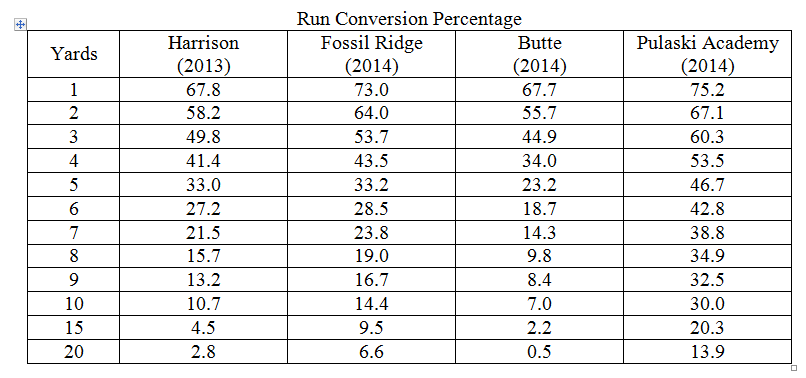
While the decision tool provided by the Excel spreadsheet does not help a coach on the sidelines on a Friday night, the data can be extracted into a useable form. The tables below show examples that would easily fit in a corner of a play sheet allowing a coach to assess the degree of "gambling" with a given play call. However, the full degree of gambling is not known unless he includes the points the other team is likely to score if a conversion fails. We discuss this analysis technique (and a couple of others) in the book.


As a note on the above tables, the conversion probability percentages for Pulaski Academy demonstrate just how potent Kevin Kelley's offense is. He knows that he can depend on ~35-40% conversion percentage on 4th down out to 10 yards to gain. This is an absolutely brutal offense to attempt to defend. To learn more about decision making tools for high school coaches, pick up an eBook copy of Saturday Morning Wake-Up Call at your favorite bookseller for just $0.99.
The paperback version is also available in these retail outlets for just $5.99:


Wednesday, August 20, 2014

2013 Harrison Data Example

In our book, Saturday Morning Wake-Up Call, we discussed processing data to help coaches make better decisions on 4th down. In writing the book, we developed a couple of templates for easy processing of the play data from a high school season. In the time since then, we have modified and expanded on the tools that were developed. This post will show you some of the results when the 2013 Harrison Goblin play data is used.

The 2013 Harrison Goblins database for plays that we used had 306 runs and 281 passes. The probability distribution functions (PDFs) for the data are found in Figure 1. The PDFs provide the probability of the yards gained for a play within the Harrison offense last season.

Figure 1. Probability Distribution Function for 2013 Harrison

There are two other distribution functions (the cumulative distribution function [CDF] and the complementary cumulative distribution function [CCDF]) derived from the same data. Those functions are found in Figure 2 and Figure 3.

Figure 2. Cumulative Distribution Function for 2013 Harrison

Figure 3. Complementary Cumulative Distribution Function for 2013 Harrison

The most useful data to a coach in the 4th down decision making process are the CCDFs. Essentially, the CCDF will describe the probability that a team will gain AT LEAST a given number (X) yards. We have built an Excel tool to query the CCDF to give a coach the probability of gaining the yards needed for a 1st down with either a run or a pass play. Figure 4 shows a screen shot of the data query sheet of the Excel tool.

Figure 4. Screen Shot from Excel Decision Tool

The tool does not provide a coach with much help on a Friday night, but a table for inclusion on a play call sheet is easily created. A sample table created using the data and tool above is found in Figure 5.

Figure 5. Sample Play Sheet Table Using 2013 Harrison Data

The table above would fit in a corner of a play sheet allowing a coach to assess the degree of "gambling" with a given play call. However, the full degree of gambling is not known unless he includes the points the other team is likely to score if a conversion fails. We discuss this analysis technique (and a couple of others) in the book.

We are looking forward to a great 2014 high school football season in the Natural State. To learn more about decision making tools for high school coaches, pick up an eBook copy of Saturday Morning Wake-Up Call at your favorite bookseller for just $0.99.
The paperback version is also available in these retail outlets:


Friday, January 31, 2014

Paperback Version of Saturday Morning Wake-Up Call Available

As we mentioned in a previous post, we moved forward with the plan to make Saturday Morning Wake-Up Call available in paperback. We used the CreateSpace publishing service to get that done. The direct link to the book on CreateSpace is found below:
Saturday Morning Wake-Up Call is also available at Amazon. Here is the link to the book page there:
We have enrolled the book in the "Kindle Matchbook" program with Amazon. If you buy the print edition through Amazon, then you can buy the Kindle edition of the book FREE. If you choose to buy from another retailer, then let us know. We will send a gift copy of  Saturday Morning Wake-Up Call from Smashwords.

Wednesday, January 22, 2014

Book Available at the World's Largest Bookseller (FINALLY!)

We have spent close to a year and a half simply waiting for Amazon and Smashwords (our eBook distributor) to work through the technical difficulties of bulk distribution of independent authors to the Amazon store. So, for a year and a half, Saturday Morning Wake-Up Call was missing from largest bookseller in the world. In our stubbornness (or laziness), we had chosen not to investigate the Kindle Direct Publishing (KDP) platform that Amazon offered us.

Well, those days are over. Over the last few days, we went through the process of preparing the electronic format required to publish on KDP. So, simply follow this link directly to the Amazon store site for Saturday Morning Wake-Up Call. We believe that the only thing left to do is to investigate the print version of the book with CreateSpace.

Other Retailers

Smashwords has (long ago) provided the book to many retail outlets including its own retail site. As a side note, we get a higher royalty percentage for Smashwords sales, AND you get the book in any format you want (.mobi, .pdf, .ePub, .lrf, and .pdb as well as the ability to read online). This means that you don't have to be locked into an eBook eco-system by purchasing our book. Finally, if you think you would like to copy of the book and will agree to review the book, we will send you a coupon to download a free copy at Smashwords. Simply email us at arkansasfootballbloggers@gmail.com with the subject "Book review" and we will send you that free copy.

Saturday Morning Wake-Up Call is available at these retailers:
Saturday Morning Wake-Up Call is also available through these "Netflix for eBooks" type apps:

Wednesday, January 15, 2014

2014 Kickoffs and Updates

Saturday Morning Wake-up Call

We have decided to permanently lower the price of Saturday Morning Wake-Up Call to just $0.99 while we move on to our next project - a "Quads" playbook.

The price change has taken place at Smashwords (our eBook distributor). However, the change often takes a few days to a week or more to ripple through to the other retailers. As a side note, we get a higher royalty percentage for Smashwords sales, AND you get the book in any format you want (.mobi, .pdf, .ePub, .lrf, and .pdb as well as the ability to read online). This means that you don't have to be locked into an eBook eco-system by purchasing our book. Finally, if you think you would like to copy of the book and will agree to review the book, we will send you a coupon to download a free copy at Smashwords. Simply email us at arkansasfootballbloggers@gmail.com with the subject "Book review" and we will send you that free copy.

Saturday Morning Wake-Up Call is available at these retailers:
We are still deciding how to handle Amazon distribution because they have dragged their feet with respect to bulk distribution from eBook distributors such as Smashwords.

Saturday Morning Wake-Up Call is also available through these "Netflix for eBooks" type apps:

Quads Playbook (We are still working on the final title)

We have the essential outline of a quads playbook that will illustrate successful plays out of the 4 x 1 formation against multiple coverages and defensive schemes. The book will include QB read progressions as well as receiver responsibilities for each of the plays in the book. We are still working on drawing the plays in the proper format for eBook distribution as well as deciding on the final price point. Our plan is still be finished by the time coaches and teams gear up for 7-on-7 tournaments in late Spring 2014, but our progress has been slow thus far.

Arkansas 7-on-7 Football Site Updates

Over the next few weeks, we will be completing the 2013 Arkansas High School Football Scoreboard page while taking down the 2013 schedule page. We will be contacting high school coaches in the state to find out tournament and team camp dates. We will also ask for their input so that we can construct the 2014 Arkansas High School Football Schedule page. In addition, we will make our annual request to the college football coaches and sports information directors in the state to get their schedules for the summer. So, please visit us often to get the most complete information on summer football activities in Arkansas and some of the surrounding states.

Monday, June 10, 2013

Where Can I Get "Saturday Morning Wake-Up Call"

We are happy to announce that our book "Saturday Morning Wake-Up Call" is now available from many eBook retailers including Smashwords, Barnes & Noble, iTunes, and Sony. Here are the links to the book pages at the various retailers:
The retail price of the book is $2.99. However, we are running a long term discount on the book at Smashwords to encourage others to discover books there.
  • $0.99 for Saturday Morning Wake-Up Call
    • Use Coupon Code "XK88N"
Please "Like" our Facebook book page:
https://www.facebook.com/SaturdayMorningWakeUpCall


*** ~~~ ***

We have also become a part of Operation eBook Drop. The indie authors in this program give away their eBooks to active duty service members. If you are in the service and would like a copy of our book, please send us an email at arkansasfootballbloggers@gmail.com. You can also sign up at the Operation eBook Drop Facebook page to receive free books from almost 1500 indie authors. Finally, if you have a friend or family member that is serving, let them know about this program (and our book). We will be sure to send them a free copy.

Monday, August 27, 2012

Saturday Morning Wake-Up Call Available

Finally, we have finished the book that we have been working on for about 8 months now, Saturday Morning Wake-Up Call - just in time for football season. The book is available for $3.99 from Smashwords.com (and we anticipate it will soon be available at other eBook retailers). We have coupons for a free copy for the first five Arkansas 7-on-7 Football readers to send an email to arkansasfootballbloggers@gmail.com requesting a copy. All other Arkansas 7-on-7 Football readers can use this coupon code (CK94N) for $3 off the list price until September 27, 2012.

Here is the "Extended Description" of the book:
"The conclusions drawn by analyzing statistics from college and professional football often do not translate to the high school game because the games are so different. This book puts those powerful statistical techniques for maximizing a team's chance of winning into the hands of high school coaches and fans. These techniques are illustrated using the Pulaski Academy Bruins as a case study.

Techniques such as Expected Point Value and Points Per Possession analysis are demonstrated with examples. The authors explore the utility of onside kicks, 4th down decision making, and two point conversion attempts. In addition, the book touches on the aspects of game theory as it relates to the opponents psychological state.
"

Friday, August 3, 2012

2012 Post 7-on-7 Season Updates

Now that teams have finished the 7-on-7 circuit for 2012, they are starting to look forward to the real football season. We are doing the same thing here at Arkansas 7-on-7 football. We have a conference-by-conference version of the 2012 Arkansas high school football schedule available on one of our page links in the left column. In addition, we have completed the 2011 Arkansas high school football scoreboard page (also in the page links).

The schedule page contains an open date summary for those still looking to fill a schedule, but that will go away as the open dates pass. The schedule page will also morph to the 2012 Arkansas high school football scoreboard page as the games are played. Each week during the season, we will have an individual post for the games scheduled that week and a results page. We will once again highlight the high scoring teams and identify any surprises.

Finally, as the season closes in on us, we are putting the final wraps on the book we have been working on for about 7 months now. Here is a look at the sample cover. The book will be priced at $3.99 from Smashwords.com (and will be available at other eBook retailers). Once the publication is complete, we will have coupons for a free copy for 5 Arkansas 7-on-7 Football readers with additional discounts coupons for the next 30 readers.

Here is the "About the Authors" section from the book:

K. Russell DePriest

Russell is a native of Mena, Arkansas, and he is a 1992 graduate of Mena High School. During his time at Mena High School, Russ earned 10 athletic letters in 3 sports (football, basketball, and baseball) including 2-time All-District honors in football and All-District honors in baseball. He received a B.A. in Physics (summa cum laude) from Hendrix College (Conway, AR) while lettering 3 times for the Hendrix Warrior varsity baseball team. Russ earned an M.S. in Health Physics and a Ph.D. in Nuclear Engineering from Texas A&M University (College Station, TX). He is currently a Principal R&D Scientist/Engineer in the Applied Nuclear Technologies organization at Sandia National Laboratories located in Albuquerque, New Mexico. He serves as Principal Investigator for the Neutron and Gamma Energy Transport (NuGET) Advanced Simulation & Computing software development project. Russ is a voting member of 2 ASTM International Committees (E10 - Nuclear Technology & Applications and E61 - Radiation Processing). He was recently selected by an ASTM subcommittee to be the Technical Program Chair for the 15th and 16th International Symposium on Reactor Dosimetry. He is also Assistant Director of the μEP Graduate Program at the University of Arkansas. Russ has authored or co-authored more than 10 peer-reviewed scientific publications in the last 15 years.
Russ telecommutes to Sandia National Laboratories from Fayetteville, Arkansas where he lives with his wife and 2 adopted daughters. He enjoys reading (mostly science fiction and science history), discussing sports and statistics, tinkering with an essentially useless Texas Hold’em poker analysis code that he has written, and complaining about both the Fightin’ Texas Aggie football team and the state of science literacy in this country. You can find out about all these things and more on his Minimum Publishable Unit (MPU) blog (http://depriest-mpu.blogspot.com/).

Adam DePriest

Adam is a native of Mena, Arkansas, and he is a 1998 graduate of Mena High School. Adam earned 10 athletic letters, 3 each in football and basketball and 4 in baseball. Upon graduation, he was named an Arkansas Distinguished Governor’s Scholar and attended Ouachita Baptist University (Arkadelphia, AR) where he received a B.S.E. in Mathematics. While at OBU, Adam earned 4 letters for the Tiger baseball team while garnering mention on the Gulf South Conference Academic Honor Roll twice and recognition on the Lone Star Conference All-Academic Team. From August 2002 – May 2012, Adam was part of the football coaching staff at Pulaski Academy (PA) in Little Rock, Arkansas. He has focused on receivers and special teams while assisting with defensive backs early in his career. The Bruins have won 3 state titles and been in the state finals 5 times in his 10 seasons with an overall record of 113-22-1. The PA offense has averaged 530 yards and 45 points per game over the last 6 years (82 games). In 2008, the Bruins lead the nation in total offense with 564 yards per game. In 2011, the PA Bruins won the inaugural Mel Kiper Jr 7-on-7 National Championship. In May 2012, Adam became the Offensive Coordinator at Harrison High School in northwest Arkansas.
Adam lives in Harrison, Arkansas with his wife, 2 sons, and daughter. His family is often host to foster children. Adam remains one of the key organizers of the highly praised Shootout of the South (a 2 day, 24 team 7-on-7 football tournament held in Little Rock). He is also gifted in putting together team and individual highlight videos. Adam enjoys following the Arkansas Razorbacks (all sports) and the St. Louis Cardinals.

Russ and Adam
Russ and Adam both were both Valedictorians of their Mena High School graduating classes (1992 and 1998, respectively). In addition both were named the James C. Copher Award winner at Mena High School for their respective senior classes. The award recognizes the outstanding senior male athlete at Mena High School. The brothers have published the Arkansas 7-on-7 Football blog since May 2008 (http://7on7football.blogspot.com/).

Tuesday, June 21, 2011

2011 AAA Dead Period -- Misunderstanding of Southern 7-on-7 Football

Well, we have reached the Arkansas Activities Association Dead Period for 2011.  Of course, that doesn't mean that the AAA has suspended its activities.  They will be hosting All-Star games while the teams are on "vacation."  So much for a needed rest for the coaches in the state.  In any case, we didn't want to abruptly go away for 2 weeks. We found a couple of articles from Michigan that claim that Armageddon is coming there because 7-on-7 football is becoming popular in that state.

Links 

The writers of these articles don't understand 7-on-7 in the South in general and Arkansas in particular. The worry is that we will have AAU style football with agents, shady characters, and all the rest once these events get out of control. However, in Arkansas, the high school teams field 7-on-7 squads, and in general, coaches run the 7-on-7 events in the state.  We haven't seen AAU style teams being assembled simply because the coaches in the state are using these events to improve their team for the next season. In addition, the coaches running the events could simply refuse entry to their events for "all-star" teams. 

It seems to us that the problem with the 7-on-7 described in the northern/mid-west states is that the high school coaches are giving the opening to the shady characters.  Let us know if you think that this issue is being overblown in Michigan.  Also, do you see this as a problem in Arkansas?

Saturday, May 28, 2011

Now is a great time to subscribe ...

... to Arkansas 7-on-7 Football. We are not asking you to buy anything. We would simply like you to subscribe to our RSS (Really Simple Syndication or Rich Site Summary) feed. For those unfamiliar with RSS, sites that update their content frequently use RSS to syndicate (or publicize) when their content has changed. The feed is published in a standard format (for you web geeks, XML) so that the subscriber can pick his/her favorite feed gatherer. You have likely seen a button like this on our (or another) website:


The summer season in Arkansas is just about to kickoff with the Sonic Air Raid and the Fenter Physical Therapy Air Devil 7-on-7 Tournament next Saturday, June 4. We intend to give our readers as much coverage as possible. You can be instantly updated when we have new results, awards, and pictures by signing up for our feed. By subscribing, you let us know how many of you are following us on a regular basis.

If you would like more information or help getting started with an RSS feed reader, don't hesitate to contact us at arkansasfootballbloggers@gmail.com. Thanks and have a great Memorial Day Weekend! Don't forget to take time to remember our fallen American heroes.

Thursday, May 12, 2011

*Helmet Stickers - Distant Replay

Photo by Jonathan Gibson
Over the last 4 years, we have been discussing the concept that 7-on-7 competitions emphasize the importance of skill position players. They also allow the skill players to develop that all-important concept of timing between quarterback, running backs, and receivers. However, what usually comes up in the discussions is what should linemen (both offensive and defensive) be doing during the summer while the guys with the eligible numbers are "playing catch?"

We came up with very few ideas other than conditioning and weight training. So, we are looking to you guys out there for some fun ways of making sure that these big guys are involved. We are interested in how coaches make these guys understand their importance to the success of the team. Along those same lines, how do you reward OL/DL during the regular season because the media tends to concentrate on the stats of the QBs/WRs/RBs?

For example, do you make the internal team recognition (e.g., helmet stickers) more obtainable for the linemen?

Please submit your thoughts and ideas for discussion fodder.

---

*This is basically a re-post (with small changes) of an early article.  This makes it easier to find and, we hope, fodder for discussion.

Tuesday, May 3, 2011

*Belief

The spread passing game has proliferated around the state of Arkansas. Its popularity and high profile successes (most notably, the nation profile of Shiloh Christian) has made some coaches feel pressure to "modernize" their game and chuck the ball around the yard. We think that we can make the case that this is a bad idea if this philosophy doesn't suit the entire coaching staff and the players that a school has historically produced. We feel that if a coaching staff will choose a philosophy (a grind it out power, a finesse type of speed option, or a no holds barred spread passing attack) and demonstrate to the players that they believe in it, then the team will be successful because of the consistent training in the system throughout the program.

First, the implementation of a spread passing offensive philosophy must get the buy-in of the ENTIRE coaching staff. By its very nature, the spread passing attack is very aggressive and takes chances that a traditional offense wouldn't dream about. For instance, these offenses are much more likely to go for it on 4th down on their side of the 50-yard line. These decisions place more pressure on the defense and its coordinator. The risks taken can lead to big rewards, but it can also mean that the Saturday morning paper reports on some lopsided defeats if the offense has a bad night.

Most assistant coaches are early in their careers as coaches and many have aspirations of becoming a head coach at some time in the future. Thus, a defensive coordinator may not fully commit to an offensive system that places "his" defense in positions to give up lots of points. It may be difficult to convince a young coach with head coaching aspirations that he should sacrifice that career goal for the team. This means that a coaching staff implementing a new spread offense attack must be ready to address some of the possible inter-staff conflicts.

Second, a coaching staff that does not have experience with a sophisticated passing attack may find it difficult to find and develop quarterbacks that can perform with some efficiency in the system. This is another aspect of believing in your system leading to success. If a head coach (and his staff) has cut his teeth on power football or the option attack, then it is likely that he understands the fundamentals of developing QBs, RBs, and OLs for those systems. It is also just as likely that he has only a superficial understanding of what it takes to develop QBs, WRs, and OLs in a passing system.

Next, the kids in a football program know whether or not a coaching staff believes in an offensive philosophy. How? Well, for one thing, they know if the playbook and offensive formation changes from year to year. If a team runs the wishbone one year and a slot-I formation the next with no real explanation of the changes, the kids begin to understand that the coaching staff isn't sure how to best move the ball down the field and give the team the best chance of success. However, if a kid starts running the wing-T in the first practice of 7th grade and continues to run it every day until he plays his final game six years later, then he knows that his coaches believe that offensive philosophy is the best for the team. So, if the spread passing game is just another offense that the coaching staff is taking for a whirl, then it is likely to meet with little success because of the limited experience that both the coaches and players have with it.

Finally, we want to make it clear that we understand that football is still football whatever the offense that you choose to run. A well executed running attack that dominates the time of possession and puts points on the board can frustrate the wide open attacks and prevent them from getting into the rhythm need to perform at a high level. What we are essentially saying to coaches is "Know yourself and your team." This is the surest formula for a successful season.

Some of you may be wondering why we are taking the time to argue for coaches to stick with types of offenses that do not lend themselves to 7-on-7 competitions. We feel that all teams could benefit from participation in these competitions for the following reasons:
  • No matter what a team's offensive philosophy, it is almost a certainty that its defense will face a hurry-up, no-huddle spread passing offense at some point (maybe several times) during a given season. So, 7-on-7 competitions provide excellent full speed opportunities for defensive backs and linebackers to work on pass coverage skills.
  • The 7-on-7 competitions provide the ability for coaches and skill players to work on techniques and plays that may be needed in come from behind situations. We feel that it is better for QBs and receivers to have at least seen the ball in the air before trying to use passing plays in game situations.
  • These competitions provide the conditioning opportunities for the players. With regular workouts outdoors in the heat, it is less likely that players will suffer from the heat and humidity at the start of the fall campaign. Since the players will be acclimated to the heat, it will be safer for them during the extreme heat of August.
  • Finally, the coaches get a chance to stay in contact with players. While this may not seem significant for some, it is well known that participation in athletics (or other extracurricular activities) decreases the probability of mischievous activities. This contact between the coaches and players at a time of the year when the athletes have lots of free time may keep some of the kids out of trouble.
While we may not convince you that a spread passing attack is the best offense for your team (and we are pretty sure we don't want to do that), we hope that you will consider some of the possible advantages in becoming involved with this fast growing derivative of that offensive philosophy.

--

*This is a re-post of an early article.

Sunday, April 24, 2011

*Cover 2 Pass Defense in 7-on-7 Football

A cover 2 scheme can be very effective for a defense because it allows more defenders to stay in the shorter passing lanes or pressure the passer. However, most high school defensive coordinators get into that cover 2 the same way every time: Simply dropping the free and strong safeties into a coverage that divides the deep "halves." This scheme is a textbook rotation into a cover 2 and is one of the more simple reads for a spread passing QB. Most offensive coaches will tell you that you will have a very long night on defense if you continue to show the same look and rotate into a coverage the same way. This is especially true for the pass only offenses that you see during a 7-on-7 tournament or camp.

So, as a defensive coach, how can you vary the coverage rotation so that you keep as many defenders as possible in the short zones while still playing a fundamentally sound cover 2 scheme? This article is intended to give a defensive coordinator some different ideas to confuse and frustrate a passing attack that usually feasts on cover 2.

In the video below, we first show a cover 2 base defense versus a "Doubles" formation. We then show different ways to rotate into that coverage beginning with a cover 3 base. Here is the order of the slides in the video.

1. Base Cover 2

2. Dropping the SS back to halves and rotating FS and LB's accordingly. As stated above, this is the most popular method to roll into cover 2.

3 & 4. Shift the LB's out to cover for a CB that will drop into deep halves. #3 is the same as #2, just going the opposite way.

5. Pull the FS down and drop the SS and OLB into deep halves.

6. This is not roll as much as a variation of cover 2. Cover 2 Buc (or Tampa 2) which is actually a hybrid cover 3 of sorts as the MLB drops into the deep middle while the two safeties can cover further outside the hash. This keeps teams from exploiting the deep middle -- the weakness of the cover 2 defense.


By no means is this an exhaustive list, but hopefully this will give you some ideas to work from. The reason this can be effective is that, when you are facing good teams where the quarterback is making pre-snap reads and the receivers are adjusting routes based on coverage, it can confuse either or both. This confusion will lead to positive plays for your 7-on-7 defense.

--

*Since older posts are sometimes hard to find, we are re-posting this.  We hope this helps in developing a successful scheme for your 7-on-7 football defense.

Wednesday, April 20, 2011

"Head Games: Football's Concussion Crisis" Book Review*

Since we are an "All Things Football Related" type of blog, we felt that a book review dealing with a hot topic in high school, college, and pro football might be a good idea. I finished this book a little over a year and a half ago. The conclusions and story stay with me to this day.

--
  • Title:  "Head Games: Football's Concussion Crisis"
  • Author:  Christopher Nowinski
  • Synopsis:  This book is a mixture of many things: autobiography, lessons learned, advocacy, etc.  Nowinski tells the story of his battle with multiple concussions and warns football players, families, and coaches of the danger of not taking concussions seriously.
  • Impression of the book: I was impressed with Nowinski (Harvard football player turned professional wrestler) and his ability to tell a really sad story that continues to wreak havoc in his life.  I closed the book feeling both sad for him and fortunate that  I walked away from football mostly unscathed.
Nowinski tells a story that is perhaps familiar to many that have played high school and/or college football. He has multiple instances of getting dinged, having his bell rung, etc.  What football players, coaches, and professional wrestlers don't realize is that each of those cultural phases for going loopy after hit are basically the recognition of the symptoms of a concussion (without actually saying concussion).  I had ONE pretty serious concussion as a high football player, but thinking back on my career, it is likely that I had multiple "minor" concussions that never took me out of the action.

Head Games: Football's Concussion Crisis from the NFL to Youth Leagues
This book caused me a lot of consternation, but it also confirmed a lot of my beliefs about youth football. I am one that believes that tackle football at ages less than middle school/junior high is counterproductive.  First, there is such a great disparity in body size at young ages that there is an inherent problem of the smaller players quitting (or never starting) because of the size mismatch with larger kids.  Second, there is nothing that is taught or learned at those young ages that is neglected in higher levels of football.  Finally and probably most importantly, the coaches of these Pop Warner or Pee Wee leagues don't have the training to recognize the signs of head injury.  For that matter, neither do some high school or college coaches if we are to believer the reports from Texas Tech last season.

I think that every youth, junior high, and high school football coach should read this book.  I think that coaches care about their players. Living with the fact that they could have prevented an injury (or death) of a player would be extremely difficult.  I also recommend this book to anyone involved with high school athletics.  Finally, I would recommend that high school coaches associations around the country bring in neurologists or other doctors to train/inform coaches on the dangers of head injuries for adolescents.  Emphasizing the dangers might reign back some of the cavalier attitude toward head injuries that can be seen on almost any Friday night during football season.

--

*This review was originally posted on my "general" blog:  The Minimum Publishable Unit (MPU).

Tuesday, October 19, 2010

Looking for Blog Banner/Web Graphics?

Over the last 6 months or so, we have designed a few blog banners for the websites that we touch in some way.  You can see three examples of our work below. We are looking to expand what we do a little bit and we want to work with bloggers to produce custom blog banners.

If you are looking for someone to produce a blog banner or other graphics for a web page, give us a shout at arkansasfootballbloggers@gmail.com. We are willing to work with you on reasonable prices, and we will provide you with great graphics for your site. We can use your image/idea, or you can give us guidelines and let us shoot for what you have in mind.


4th and 10


Tales from the Krit


Arkansas 7-on-7 Football

Thursday, March 25, 2010

Playing "Cover 2"

A cover 2 scheme can be very effective for a defense because it allows more defenders to stay in the shorter passing lanes or pressure the passer. However, most high school defensive coordinators get into that cover 2 the same way every time: Simply dropping the free and strong safeties into a coverage that divides the deep "halves." This scheme is a textbook rotation into a cover 2 and is one of the more simple reads for a spread passing QB. Most offensive coaches will tell you that you will have a very long night on defense if you continue to show the same look and rotate into a coverage the same way. This is especially true for the pass only offenses that you see during a 7-on-7 tournament or camp.

So, as a defensive coach, how can you vary the coverage rotation so that you keep as many defenders as possible in the short zones while still playing a fundamentally sound cover 2 scheme? This article is intended to give a defensive coordinator some different ideas to confuse and frustrate a passing attack that usually feasts on cover 2.

In the video below, we first show a cover 2 base defense versus a "Doubles" formation. We then show different ways to rotate into that coverage beginning with a cover 3 base. Here is the order of the slides in the video.

1. Base Cover 2

2. Dropping the SS back to halves and rotating FS and LB's accordingly. As stated above, this is the most popular method to roll into cover 2.

3 & 4. Shift the LB's out to cover for a CB that will drop into deep halves. #3 is the same as #2, just going the opposite way.

5. Pull the FS down and drop the SS and OLB into deep halves.

6. This is not roll as much as a variation of cover 2. Cover 2 Buc (or Tampa 2) which is actually a hybrid cover 3 of sorts as the MLB drops into the deep middle while the two safeties can cover further outside the hash. This keeps teams from exploiting the deep middle -- the weakness of the cover 2 defense.


By no means is this an exhaustive list, but hopefully this will give you some ideas to work from. The reason this can be effective is that, when you are facing good teams where the quarterback is making pre-snap reads and the receivers are adjusting routes based on coverage, it can confuse either or both. This confusion will lead to positive plays for your 7-on-7 defense.

Saturday, January 30, 2010

National Signing Day*

If you follow college football to any real degree, you know that the culmination of a recruiting season is just around the corner.  Next week, we have "National Signing Day" when high school players from across the country make their decision on where they will play college ball.  While I did live in Texas for a while (where there are just 2 seasons - Football and Recruiting), I never did buy into the hype surrounding the recruiting rankings.  Every year, Notre Dame finishes in the Top 5-10 in recruiting (they win the National Recruiting Championship every couple of years), but somehow, those blue chippers never seem to pan out.

I have several theories on why that recruiting high school players (or drafting college ones) is such an inexact science. First, with "top level" high school players, you never really get to see them compete against guys of comparable athletic ability.  Whether it is the best RB in Nebraska or the top LB in Minnesota, the talent around them and against them makes the evaluation process difficult.  I know that many states have started "recruiting combines" to allow prospects to perform against others in standardized tests of athletic ability. These combines don't get at the true football player, though.

Second, recruiting ranking services are in the business of making money.  They don't sell as many magazines or website subscriptions if they are telling Irish fans that the recruits the coach is bringing in are not as good as the recruits TCU or Boise State has.  It has been my experience that certain schools (e.g., Florida, Texas, Alabama, USC) showing interests in a kid brings up ratings while those same schools can drop a kid's rating by dropping out of the sweepstakes for his talent. While this is anecdotal, I don't know how to measure it any other way.

Finally, I am one that believes winning feeds itself.  Bowl teams get extra practices (15 or so) to develop those "blue chippers" that non-bowl teams don't get.  These extra practices allow the players at those schools to develop on a quicker schedule.  Thus, whether or not the recruiting rankings have any merit is nullified by the extra experience the top schools get during bowl practices.

In any case, I refuse to get disappointed over the whimsical choices of 17- and 18-year old boys.  I do hope the kids are choosing schools that fit them rather than who is the coach.  As we have seen recently, even the most secure coaches (Urban Meyer) aren't guaranteed to be there for graduation.  I know, that's old fashioned, but we are talking about COLLEGE football.

---

*Cross posted at 4th an 10.

Wednesday, November 18, 2009

Bill Belichick vs. 31 Other Coaches*

It's certain that you have seen by now the Bill Belichick decision to go for it on 4th down last Sunday. It's almost a given that you have heard how terrible, foolish, etc. it was for him to not trust his defense. The real question for me, "Is did Belichick improve his chance of winning the game?" I know this will be hard for many of you to believe, but the answer is YES! By going for it in that situation, Belichick increased his chance of winning from 70% to 79%.

HOW CAN YOU SAY THAT!!!

Well, it's not me, but statistics from hundreds of NFL games using expected outcomes of any given situation. If you haven't seen the website that analyzes this type of situation for many games, it is called Advanced NFL Stats. Here is the link to the analysis that shows Belichick was right. AND, there was fallout from the initial analysis claiming that it was faulty, so here is the link to the rebuttal column that was posted later.

So, why the dustup for Belichick over this? That is pretty simple. It just proves that the majority of coaches (31 out of 32) in the NFL are optimizing a different variable than chance of winning. It is my opinion that coaches are minimizing the "media exposure/fan outcry" variable rather maximizing the chance at winning. Belichick may not have known the exact numbers produced by the Advanced NFL Stats, but he knew for certain that making the 1st down seals the game.

The real question is how do fans allow themselves to fall victim to supporting strategies that work against the team's chance of success? For one, the coaches have put up a smoke screen that allows them to shift the blame/risk from himself to the players/defense. Really, I think it is simply that the coaches (and fans) don't know the optimum strategies, or the coaches refuse to take the heat for a winning strategy (by statistical analysis) that fails in a given instance. You will find VERY similar arguments in baseball when discussing the "manufacture" of runs. In that case, bunting, stealing bases, and other small ball, work against the team that implements those strategies. However, that idea is accepted as sound strategy by almost everyone in the game.

So, here's to Belichick. It takes guts to make the right decision, and he continues to lead in that category. One other thing, what do you think the media would have said in these two situations?
  1. Pats make the 1st down and win the game against the Colts.
  2. Pats punt and Manning drives the Colts 65 yards for the win.
Let us know what you think the buzz would have been with those outcomes.

------

*This article is cross-posted at 4th and 10.

Tuesday, October 13, 2009

Following College Football

We know that you are here because you like football whether it's high school or summer 7-on-7 (and probably college and pro). One of our buddies has started a blog that discusses college football rankings and highlights weekly matchups. He also complains about a lot of things that college fans despise about the current bowl system and the biases of the media/polls. Please stop by and let him know what you think:

4th and 10 Blog

We think he can take it, but we want you to find out for us.

Thursday, May 7, 2009

Public Versus Private Schools in Arkansas*

-------

*Wally, you probably need to read this.

-------

On Thursday, May 7, 2009, Wally Hall published a wildly inaccurate and silly "Like It Is" about private schools and financial aid to student-athletes. We will dissect many sentences and paragraphs in that article. Please follow this link and read column yourself to make sure we are not taking the cranky old columnist out of context.

Wally wants to make this an issue of sportsmanship, which it may very well be. He probably could have used lots of examples of good sportsmanship. However, he chose to use the example of a 1974 game in which Elkins beat Winslow 48-0 but held down the score by punting the ball through the endzone when they got to the one yard line. John Bunch broke a national record in that game by rushing for 608 yards. He ran the ball 38 times. If Elkins was showing such great sportsmanship that game, then why in the world did their starting running back play the entire game and carry the ball 38 times?

Let's imagine for a second that Shiloh decided they no longer wanted to score once the game got out of hand, but instead wanted to use the Super Sportsmanlike 1974 Elkins Elks way of keeping the score down. Instead of bringing in their 4th string QB, they leave their entire first string guys in but are punting the ball through the endzone every time they get close. Is Wally going to write about how "sportsmanlike" they are because they only won 35-0 in racking up 800 yards of offense?

Our next beef is that Wally accuses Pulaski Academy (PA) of running up the score by going for it on 4th and 15 on their own 10. We have many things to say about this:
  • Most coaches do not agree with Coach Kevin Kelley when it comes to punting. They have called him a "riverboat gambler" or "crazy," AND they think that the strategy will come back to haunt him someday.

  • Coach Kelley is convinced that punting in almost any situation works AGAINST his team's chances of winning, and he has statistics to back that up.

  • It is either one or the other, but it can't be both.
Most casual observers would look at the situation and think that Coach Kelley is giving the opponents the opportunity to have the ball at the 10 yard line (going in). However, Wally views this as running up the score. What kind of screwed up logic is that?

Next, Wally accuses both Shiloh Christian (SC) and PA of running up the score. PA finished the season 13-1 and the average game was 50-26 while SC finished 13-1 and the average game was 47-14. You will see similar numbers for Junction City (a public school) or Fountain Lake (a public school). As a matter of fact, Fountain Lake won their semi-final game 70-0 over the Lavaca and Junction City beat Norphlet by that same 70-0 score. Where is the call for either of these teams to be bumped one classification OR have them play in their own playoff.

Near the end of the column Wally writes, "There is no such thing as a scholarship at a public school." Unless I am mistaken, EVERY student at the government funded schools in Arkansas attends without paying tuition. They are each provided with a "scholarship" by the same taxpayers that are sometimes paying someone else (i.e., private schools) to educate their children. By the way, the students that go to private schools don't get the benefit of that tax money. It is simply gone.

Obviously, you can see where we stand on this issue. We think that private schools should be allowed to play public schools for championships. However, we also believe that if a school, private or public, is doing anything illegal such as recruiting, then they should be harshly punished and should be banned from postseason play in all sports.

It should also be noted that if this is really an issue of "running up the score," then this should be punished across the board for anyone who is guilty. Connecticut has a rule that if a team wins by 50 or more points, then their coach is suspended the following week. We wouldn't mind seeing that rule, but we would add to it that if it happens twice, the coach be suspended for the remainder of the season. We're pretty sure the Junction Cities, Shilohs, and Fountain Lakes would be able to find a way to keep the scoreboard down if that were the case.

Lastly, we will admit that there is an issue that needs to be resolved. The answer may be to move up Shiloh and PA a class or two or all the way up to 7A. We don't have the answers, but we think it would be a black eye for Arkansas high school athletics not to include some of these very good teams in their championships among all the schools.

We would love to hear your thoughts. Have a good weekend!